


How to choose your MTB bottom bracket?

The main purpose of an MTB bottom bracket is to keep your crankset turning as smoothly as possible. This component must be compatible with both the MTB frame and the crankset standards. With all the different frame and crankset standards, a little help is welcome!
The standards
- Bearing quality: steel or ceramic
- Crankset spindle types: Hollowtech, GXP, BB30, ...
- Frame bottom bracket shell types: BSC, Press-Fit, ...
Types of bottom bracket
Let’s start with the simplest factor: bearing quality. Manufacturers generally offer the same bottom bracket model in two versions: one with steel bearings and the other with ceramic bearings. Ceramic has a surface that does not deteriorate and is harder than steel. The benefits are therefore a low coefficient of friction and a longer service life without the need for maintenance. Note that this applies only to 100% ceramic bearings, meaning both the balls and the races. Their cost, however, makes them a choice for experienced riders.
When it comes to compatibility with the crankset spindle, there are different standards depending on the brand. To help you identify what you need, here is a list of the most common ones:
If the crankset spindle is part of the bottom bracket:
- a Octalink version 2: cylindrical spindle with eight 9 mm-long splines.
- b ISO square taper: a tapered square spindle measuring 12.5 mm at its end.

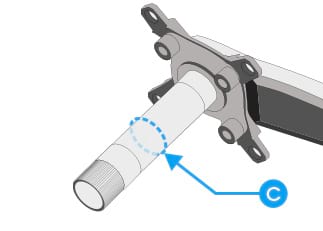
If the crankset spindle is part of the MTB crankset, also known as an integrated spindle:
 |
 |
 |
|
Hollowtech II, X-type, MegaExo 24 mm diameter spindle a. |
GXP 22 mm diameter spindle on the left b1, 24 mm on the right b2. |
BB30 30 mm diameter spindle c. |
 |
 |
|
|
SRAM DUB 28.99 mm diameter spindle c. |
PRAXIS M30 22 mm diameter spindle on the left e1, 30 mm on the right e2. |
You also need to check that the bottom bracket is compatible with your MTB frame standard. Here is another guide to help you find your way:
- BSC (also called BSA): the frame’s internal diameter is 34.8 mm.
- Press-Fit: the frame’s internal diameter is 41 mm.
- BB30: the frame’s internal diameter is 42 mm.
- Press-Fit30: the frame’s internal diameter is 46 mm.
REMINDER: Some MTB frames using the BSC standard have a wider 83 mm bottom bracket shell (rather than 73 mm) and therefore require a specific crankset spindle.
For fat bikes, there are two bottom bracket shell width standards: 100 mm (for a 170 mm wheel axle) and 120 mm (for a 190 mm wheel axle).
Which bottom bracket should I choose for my riding?
When replacing a bottom bracket, you may have little choice apart from bearing quality. Your choice will depend on your frame standard and crankset spindle.
Découvrez tous nos conseils & Tutoriels
MTB bottom brackets
-


SRAM DUB BSA 73mm Bottom Bracket
Regular price 21,99 €Regular priceUnit price per -

SRAM DUB PRESSFIT 89/92mm Bottom Bracket
Regular price 35,99 €Regular priceUnit price per -

Bottom Bracket SHIMANO MT501 BSA
Regular price 18,99 €Regular priceUnit price per -

SRAM DUB BSA 68/73 mm Bottom Bracket
Regular price 29,99 €Regular priceUnit price per -

RACE FACE CINCH BSA/BSC 30mm Axle 68/73mm Bottom Bracket
Regular price 34,99 €Regular priceUnit price per -


SRAM GXP TEAM BSA 68/73 mm Bottom Bracket
Regular price 29,99 €Regular priceUnit price per -


Bottom Bracket SHIMANO MT800 Press Fit 89.5/92mm
Regular price 24,99 €Regular priceUnit price per -


Bottom Bracket SHIMANO XTR SM-BB94-41A Press Fit 89.5/92mm
Regular price 34,99 €Regular priceUnit price per


